

Awards don’t tell you if the work worked. They tell you if the jury liked it. Those are not the same sentence, even though the industry treats them as interchangeable.
The jury is not your audience. Your audience is your audience. Chase that — not the metal.
Studio Notes, Creative & More
Amy Winehouse wasn’t against getting better. She was against the version of herself that other people found easier to manage — and that refusal is also where a lot of the art came from. The advertising industry keeps sending its riskier ideas to a version of rehab too: clean them up, make them safer, more manageable. The creatives who say no are usually the ones who end up on the awards stage.
The Industry Keeps Sending Its Ideas to Rehab
But here’s the uncomfortable thing about awards: they don’t tell you if the work worked. They tell you if the jury liked it. These are not the same thing.
Things I’ve Personally Witnessed at Award Shows
- Campaigns that ran for three weeks on a micro-budget winning metals.
- Campaigns that genuinely shifted sales getting ignored because they weren’t cinematic enough.
- Agencies rebuilding entire credentials decks around a shortlist.
- A shortlist. Not even a win. A shortlist.
The tell: if a piece of work is remembered internally as “the one that won” rather than “the one that worked,” check which of those two things it was actually built for.
The Real Value a Jury Does Provide
This isn’t an argument against awards. Juries force a genuine articulation of why something works, and they calibrate taste across cultures and categories in a way few other rooms do. That part is real, and it’s useful — a version of the same discipline that goes into writing thirty headlines to find the one that survives.
But confusing a Pencil with proof of effectiveness is how agencies end up making work for award books instead of making work for people. That’s when the industry quietly becomes a very well-dressed echo chamber.
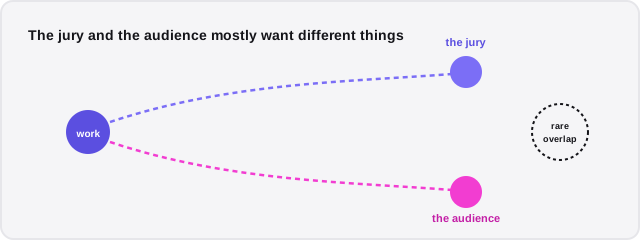
Goodhart’s Law and the Awardable Trap
Goodhart’s Law states that when a measure becomes a target, it stops being a good measure. When effectiveness is the target, you make effective work. When awards become the target, you make awardable work. These overlap sometimes and diverge constantly. The moment an agency’s internal culture starts evaluating an idea by asking “would this win at Cannes” before asking “would this work for the brand” — Goodhart’s Law has already won.
We chase alignment, not metal.
The rare cases where the audience and the jury agree — that’s what we’re actually building toward.
Chase Alignment, Not Metal
The jury is not your audience. Your audience is your audience. Sometimes those two groups agree — that’s the rarest and most valuable alignment in this business. Chase that. Not the metal.