

The more precisely you aim a piece of writing at one specific person, the wider it tends to land with everyone else. That’s the actual paradox of specificity.
We find our own specific truth inside someone else’s specific story.
Studio Notes, Creative & More
There’s a familiar pop lyric about someone being “so high above me” — written for one very specific feeling about one very specific person. And somehow, millions of people having nothing to do with that particular story still recognised themselves in it. That’s the paradox of specificity: the more precisely you aim, the wider you hit.
None of These Is a Person
How your target audience has been described in briefs I’ve personally read:
- “Men and women, 18 to 45, urban and semi-urban, SEC A and B.”
- “Everyone who uses our product.”
- “The modern consumer.”
- “People who care about quality.”
None of these is a person. None of these has a feeling. You cannot write to “people who care about quality.” You cannot look them in the eye in your copy. You cannot know what they’re afraid of, what they had for breakfast, or what makes them feel like they made the right choice.
Pick One Person
Pick one person. Name them, if it helps. Where do they actually live — not the city, the neighbourhood? What are they doing at 6pm on a Tuesday? What argument did they have last week? What are they secretly proud of?
The tell: if the “audience” in a brief could just as easily describe the population of an entire country, it isn’t an audience. It’s a census category.
The Specific Sample Represents the Population
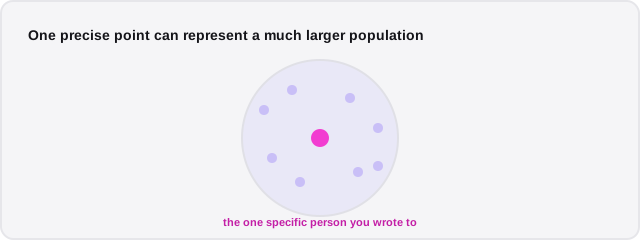
In statistics, a well-chosen specific sample can accurately represent the behaviour of a much larger population. Great creative work uses the same principle intuitively — one specific, precisely observed human moment represents a universal experience more accurately than a generic statement aimed at everyone.
Write to That Person, Then Watch What Happens
Write to that person with that level of specificity. Then watch what happens when you show the work to a room full of people who don’t match that description at all — the same test that makes a real insight land as recognition rather than information. They’ll recognise themselves anyway.
We start every brief with one named person, not a demographic slice.
It’s a smaller starting point. It produces work that lands wider, not narrower.
The Specific Is Not a Limitation
We find our specific truth in someone else’s specific story. The specific isn’t a limitation on reach. It’s a precision instrument for getting there.